Google Search vs AI Search: What's Changing for Businesses?
For many years, the first place to look for a business was Google. Someone was having issues. They looked for an answer. A list of websites was provided by Google. Companies fought for traffic, clicks, and rankings. That model is changing.
These days, users have three options: they can ask conversational AI platforms to learn more about a query and suggest a response, or they can search using the conventional method and receive an AI-generated response straight within Google. Being searchable is no longer the same as being discoverable, which presents a new problem for organisations.
Your brand needs to appear where your customers are looking for answers, including traditional search results, Google's AI experiences, and AI-powered discovery platforms. Herein lies the growing significance of AI discoverability services and a more in-depth AI search optimization approach for brands.
But first, it's necessary to understand the actual changes.
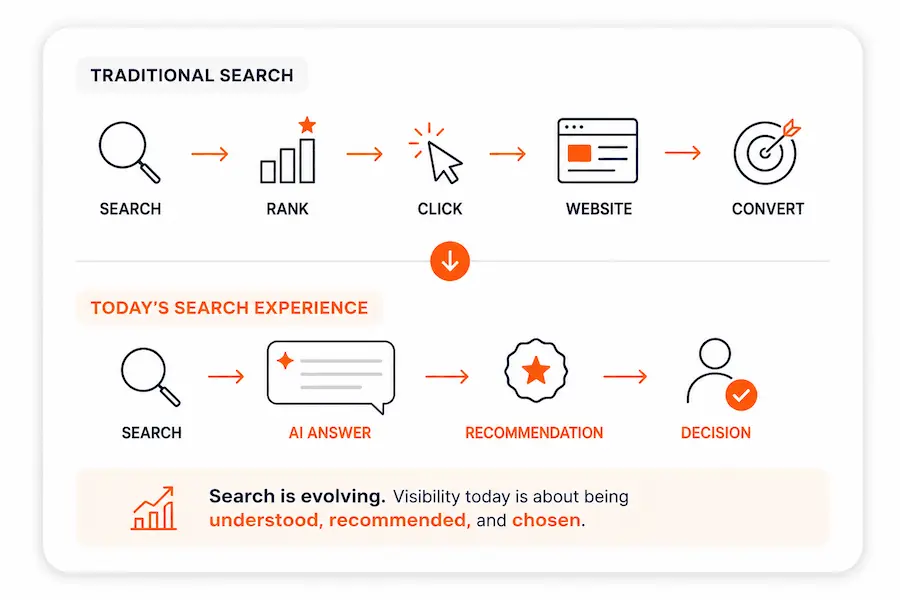 Traditional Search vs Today’s AI search
Google Search Isn't Going Away. It's Developing.
The discussion surrounding AI search frequently gives the impression that Google Search is being overtaken. That isn't really the case. Google is changing its own search.
The familiar experience of entering a query and receiving links, websites, maps, products, videos, and other results is still offered via traditional Google Search. On top of this framework, however, Google has added AI-powered experiences.
Traditional Google Search
The traditional search experience is largely built around ranking and discovering web pages.
A user might search:
"B2B demand generation agency in Singapore"
They receive a set of results and decide which links to explore. For businesses, the goal has traditionally been straightforward:
Rank -> Get clicked -> Earn traffic -> Convert.
SEO remains important because search engines still need to understand, organize, and surface useful content.
But the search experience is no longer limited to ten blue links.
What Are Google AI Overviews?
Google Search now incorporates generative AI thanks to AI Overviews.
Google can offer an AI-generated summary containing important details and links to related websites, saving visitors from having to explore multiple pages and put together an answer on their own.
Imagine someone searches:
"What should a B2B company look for in a demand generation agency?"
They might initially receive an AI-generated response that combines data from several sources rather than just a list of sites. This changes an important aspect of the visibility equation. Your company can be competing not just for a ranking but also for the chance to contribute information to the AI-generated response.
Additionally, Google has kept adding AI capabilities to Search, such as AI Mode, which makes search more conversational and able to handle more complicated queries and follow-ups.
So the question is no longer simply:
"Does my website rank?"
It is increasingly:
"Does my brand appear when an AI-powered search experience answers the questions my customers are asking?"
AI Search Goes Beyond Google
Google is just one aspect of the change.
Conversational AI technologies are being used more and more by people to explore companies, goods, services, and solutions.
Instead of searching:
"Best CRM for a growing B2B company"
someone might ask an AI assistant:
"Compare the best CRM platforms for a 50-person B2B company. Which one would you recommend and why?"
That's a fundamentally different search experience. The user isn't simply asking for a page. They're asking for an answer, comparison, explanation, or recommendation.
This is where platforms such as ChatGPT, Perplexity, Gemini, and other AI-driven experiences create a new layer of brand discovery.
The result is a shift from:
Search -> Ranking -> Click
toward:
Question -> AI-generated answer -> Sources -> Consideration -> Decision
For businesses, that means the path to being discovered is becoming more complex.
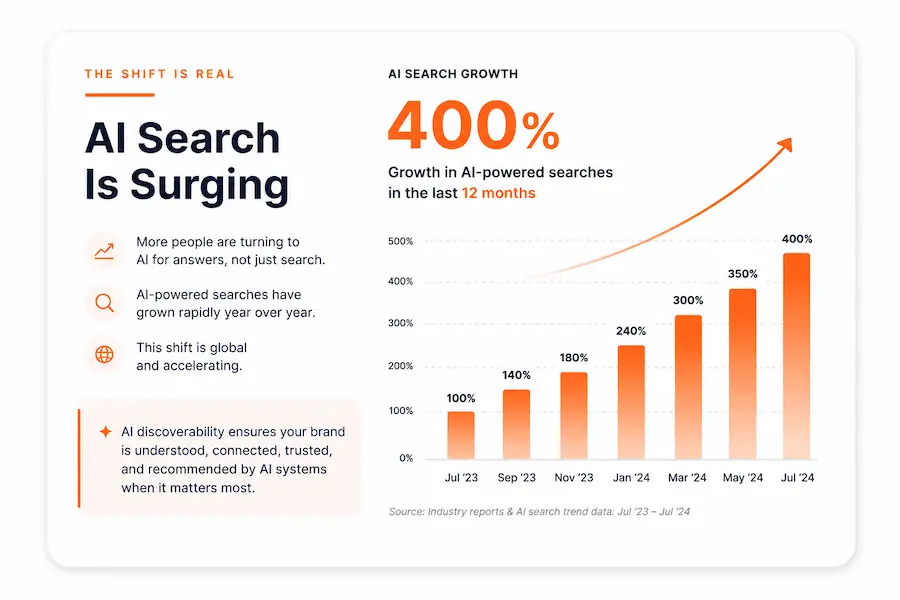 Traditional Search vs Today’s AI search
Google Search vs AI Search: What's Actually Different?
The difference isn't that one replaces the other.
It's that they reward visibility in different ways.
| Traditional Search | AI-Powered Search |
|---|---|
| User searches for keywords | User asks questions |
| Results are primarily ranked pages | Results can be synthesized into answers |
| Users browse multiple results | AI can summarize information |
| Clicks are a major visibility signal | Mentions, citations and source inclusion matter |
| SEO is central | SEO + authority + structured information + discoverability matter |
| Search intent is often keyword-driven | Search intent can be conversational and multi-step |
The important takeaway is simple:
you don't need to choose between SEO and AI search.
You need to build a strategy that works across both.
The New Visibility Layer: AI Discoverability
Traditional SEO helps search engines in understanding your website and figuring out where it should show up for relevant searches.
AI discoverability goes one step further.
It focuses on whether AI systems can understand your brand, connect it to relevant subjects, find reliable information about it, and bring it up when consumers make connected queries. It takes more than just posting blog posts. A continuous online presence is essential for your brand.
 Get your brand checked
Search Is Changing. Is Your Brand Keeping Up?
The future isn't about choosing between Google and AI. While AI Overviews, AI Mode, and chat-based AI are transforming how people find information, evaluate their alternatives, and make decisions, traditional search is still important. However, it's helpful to know where you stand right now before modifying your strategy. A simple visibility check can be a helpful place to start in this situation.
You can get a free, one-time assessment of your brand's online visibility, search engine optimization, and AI discoverability with Vesta's Brand Pulse Check. It's not about telling you to make drastic changes all at once. Giving you a better understanding of what's working, potential gaps, and what needs your next attention is the goal.
Are you wondering how visible your brand is right now?
Do a free Brand Pulse Check
Up to 3 free scans per user, per day.