Your next customer asks ChatGPT who to go to - Is Your Brand's AI Search Optimization Ready?
A potential customer has a problem. They open ChatGPT and ask:
"Which companies should I consider?"
Your business might have a strong website, years of SEO investment, and a content library. But if AI doesn't understand your brand, what you offer, or why you're relevant to that question, you may never enter the conversation. That's the shift businesses need to pay attention to.
This is where AI discoverability services are becoming increasingly important. Search is becoming more conversational. Instead of simply returning a list of links, AI platforms can interpret questions, compare information, and help users narrow down their options. And now, there's another development worth watching: AI platforms are becoming commercial platforms too.
For businesses, this raises a bigger question than "Are my rankings good?"
Is my brand discoverable when customers ask AI who they should choose?
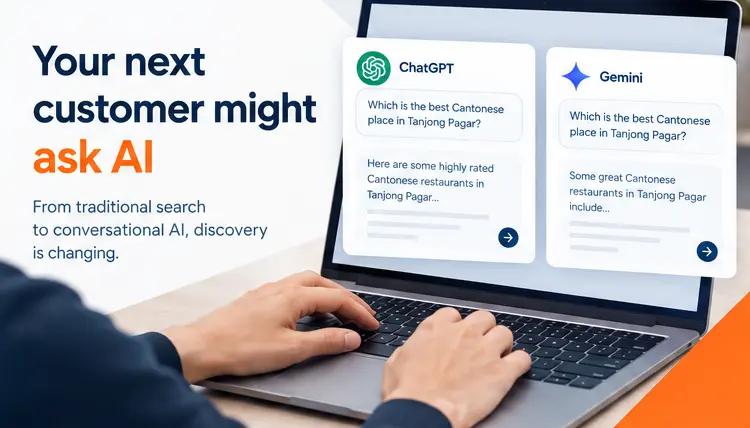
Being Searchable Is No Longer Enough
For years, digital visibility followed a fairly familiar path:
Search query -> Search results -> Website -> Evaluation -> Purchase.
AI is changing that journey.
A customer might now go directly from:
Question -> AI response -> Recommendation -> Shortlist -> Decision.
That difference matters.
When someone searches Google, they can scroll through pages of results and decide which websites to visit.
When someone asks an AI platform for recommendations, the platform can potentially do more of the filtering before the customer ever sees those businesses.
That means a brand can have strong traditional search visibility and still have a weak presence in AI-generated answers. AI discoverability isn't simply about trying to "rank on ChatGPT." It's about making your business easier for AI systems to understand, associate with relevant topics and surface when your potential customers are asking questions related to what you do.
The difference is simple:
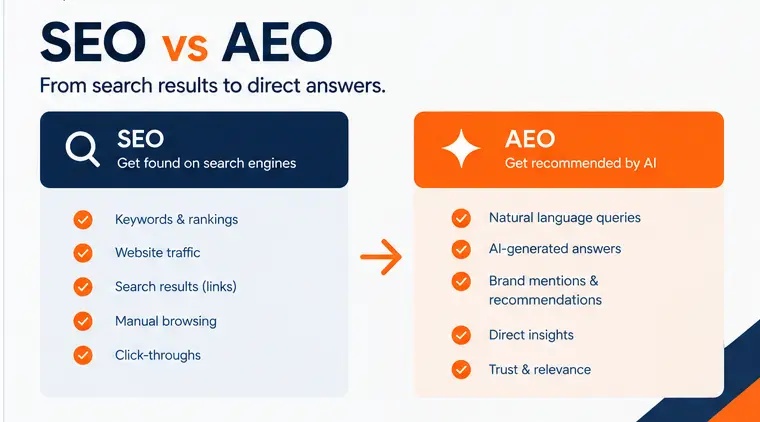
Traditional SEO asks:
Can people find my website?
AI discoverability asks:
Does AI understand my brand well enough to include it in the conversation?
That's becoming an increasingly important distinction for businesses competing for attention online.
Why AI Visibility Matters More Than Ever?
AI visibility matters because discovery happens before the buying decision. Think about a B2B buyer researching a new solution. They may ask:
- Which demand generation agencies work with SaaS companies?
- What are the best pipeline generation agencies?
- Which companies offer AI search optimization for brands?
- How should a B2B company improve its lead generation?
- What should I look for when choosing a growth marketing partner?
The buyer isn't necessarily looking for your brand yet. They're looking for an answer. And that's where the opportunity and the risk lies. If AI consistently associates your brand with the problems your ideal customers are trying to solve, you have an opportunity to enter consideration earlier. If it doesn't, your competitors may become part of the shortlist instead. For B2B companies in particular, this changes how we should think about how to build brand awareness B2B.
Brand awareness is no longer only about whether someone has heard of you. It's increasingly about whether your brand is associated with the right category, expertise, problem, and buying situation.
ChatGPT Ads Are Turning AI Into a Serious Marketing Channel
This is where the latest OpenAI developments become particularly interesting.
Search Engine Land reported on September 4 that.
"OpenAI has expanded ChatGPT Ads"
The publication says the expansion includes additional markets across Europe, India, the Middle East and North Africa, alongside new tools for audience management, conversion measurement, campaign pacing, reporting and campaign creation. (Source: Search Engine Land)
But the important part isn't simply that ChatGPT now has more advertising capabilities. It's what the development signals about the platform itself. Search Engine Land describes the updates as potentially making ChatGPT "a more meaningful part of advertisers' media plans." (Source: Search Engine Land)
That's a significant shift. ChatGPT is moving beyond being a tool people experiment with and toward becoming an environment where businesses can potentially reach audiences, influence consideration and measure outcomes. The advertising infrastructure is becoming increasingly sophisticated.
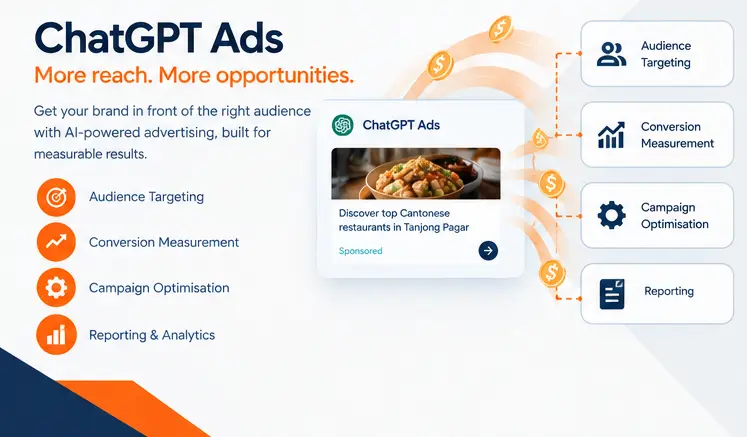
OpenAI is expanding its capabilities around:
- Audience targeting
- Conversion measurement
- Campaign optimisation
- Reporting
- Product-level performance
- Automated campaign management
CNBC states that "Our next phase of growth will bring ChatGPT Ads to more markets and introduce additional formats, objectives, buying options, and measurement capabilities," OpenAI said in a release. "We will also explore new ways for businesses to interact with consumers in more native ways in ChatGPT." (Source: CNBC)
Money Is Already Following
The commercial signal is becoming difficult to ignore. CNBC reported on August 31 that OpenAI's ChatGPT advertising business had reached a $1 billion annualised revenue run rate. (Source: CNBC)
That's not just an interesting revenue milestone. It is a signal that businesses are already spending money to reach audiences within AI-driven environments. This creates an important distinction for marketers:
Paid AI visibility and organic AI visibility are not the same thing.
You can pay for an advertisement. But you can't simply pay your way into being the answer.
Buying Visibility and Earning Visibility Are Different
The growth of ChatGPT Ads doesn't make organic AI visibility less important. It makes the distinction more important.
| Paid AI Visibility | Organic AI Visibility |
|---|---|
| You pay to reach a defined audience. | AI decides whether your brand is relevant to a user's question. |
| You control targeting, budget and campaign objectives. | Your visibility depends on how well AI understands your brand and expertise. |
| Visibility comes through advertising. | Visibility comes through relevance, authority and credible information. |
| Performance can be measured through clicks, conversions and campaign data. | Visibility can be assessed through brand mentions, recommendations and how accurately AI represents your business. |
| You can optimise campaigns based on performance. | You need to continuously improve your content, authority, structured information and digital presence. |
| Designed to capture attention through paid placement. | Designed to become part of the answer when customers are looking for a solution. |
The key difference: you can pay to place your message in front of a customer, but you can't simply pay to become the answer when that customer asks AI for a recommendation. That's why businesses should think about both paid and organic AI visibility as part of their broader digital growth strategy.
What Makes a Brand Discoverable to AI?
- Clear Positioning: Make it easy for AI to understand what you do, who you serve, and what problems you solve.
- Consistent Information: Keep your brand details accurate and consistent across your website and online platforms.
- Relevant Expertise: Create useful content that demonstrates genuine expertise in your industry.
- Structured Information: Organise key business information so search engines and AI systems can interpret it easily.
- Third-Party Authority: Build credibility through relevant publications, reviews, directories, partnerships, and industry sources.
- Customer-Focused Content: Answer the questions your target customers are actually asking, not just the keywords they search.
The Next Search Could Be a Conversation
Your next customer may not start their journey with a Google search.
They may ask ChatGPT. They may ask Gemini. They may ask an AI platform to compare providers, recommend a solution, or create a shortlist. The brands that benefit won't necessarily be the ones with the biggest marketing budgets. They'll be the ones AI can understand, associate with the right needs, and surface when the right question is asked.
For businesses, that means AI visibility shouldn't be treated as another marketing trend. It is becoming part of how brands compete for search visibility, brand awareness, demand generation, and growth.
Is Your Brand Ready for AI Search?
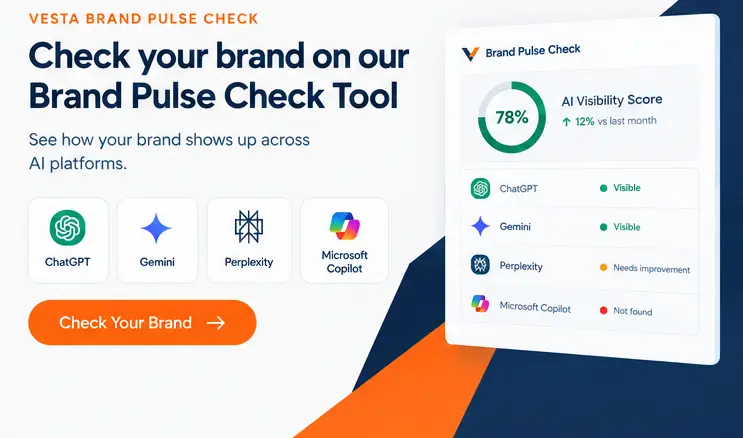
Before you start investing in AI search optimisation, it's worth knowing where your brand stands today. Vesta's Brand Pulse Check gives you a quick look at your brand's AI visibility across platforms such as ChatGPT, Gemini, Perplexity, and Microsoft Copilot.
In just 60 seconds, you can discover whether AI recognises your business, how your brand is represented, and where there may be opportunities to improve your visibility.
Don't wait for your customers to start asking AI about your competitors. Find out what AI already knows about your brand.